

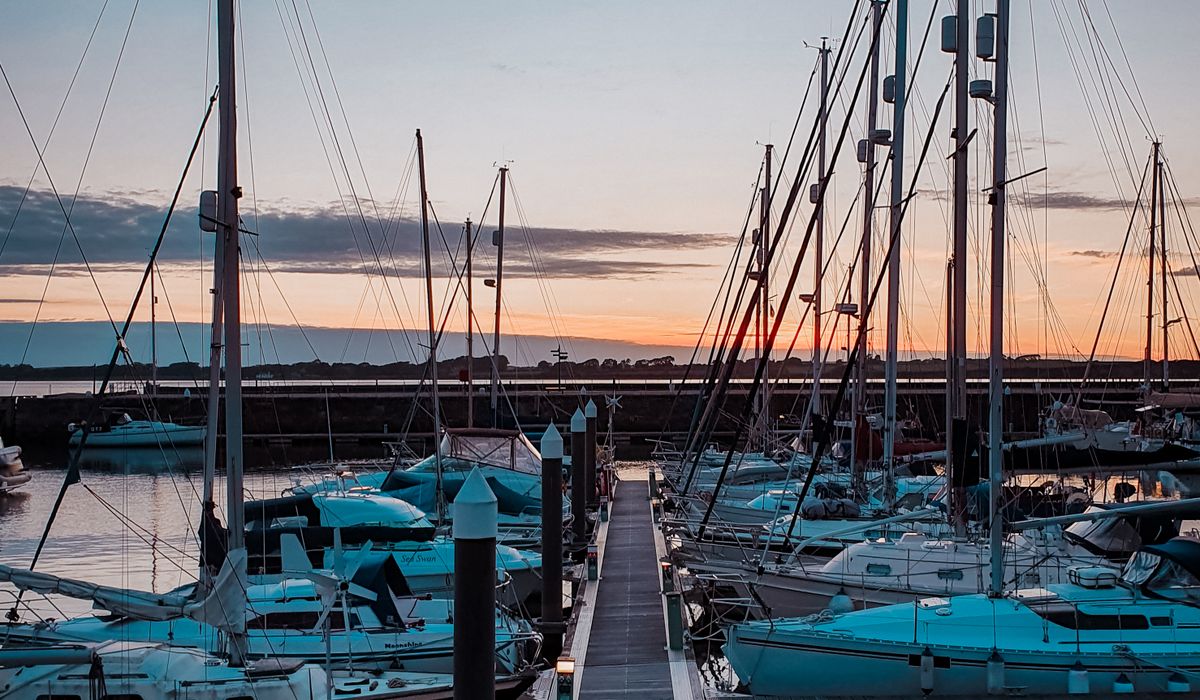
Why Harbour Villages Are Best Before Breakfast
Every harbour village in Britain has two lives. The first runs from about six in the morning until nine, when the quay belongs to the people who work there: the boat owners, the fish merchant, the man hosing down the slipway. The second begins at eleven and lasts until the pubs shut, when the same stretch of cobbles becomes a slow-moving queue of visitors. If you want to know a harbour rather than merely photograph one, plan your day around the first.
A tide table is the most useful thing you can carry. Quiet does not always mean the same hour. At high water the wall is busy with dinghies, fenders and lines; at low water the harbour floor appears, all weed, tyres and old anchors, and the banks are empty. Aim for the hour either side of high water if you want to watch boats move, and the hour either side of low water if you would rather have the place to yourself.
Back Lanes, Twittens and Cut-Throughs
The harbour front was built for trade, which is why it is wide, open and exposed. The real village sits one row back, in a network of narrow lanes that predate the quay and once carried fish, water and coal up to the houses. Every region has its own word for them: twittens in Sussex, opes in Cornwall, wynds in Scotland, ginnels in the north, chares in Newcastle. Finding them takes nothing more than walking fifty yards away from the water and looking for a passage between two buildings.
- Look for a lane running parallel to the quay, one street uphill. It usually links two slipways and passes the old net lofts, now mostly workshops and spare bedrooms.
- Follow any sign marked "public footpath". These often climb a flight of steps to a viewpoint that no road reaches.
- Walk uphill rather than along the front. Roofscape, chimney pots, back gardens and rope-hung washing tell you more about the place than the gift shops do.
- Early light comes from the east, so lanes on the western side of a harbour hold the sun and the warmth. Take a flask and sit on the first step that faces it.
Churchyards and the High Ground
In nearly every harbour village the church stands uphill from the water, often because the old settlement came first and needed the drier ground. The churchyard around it is usually the quietest public space in the village, and rarely has more than one other person in it.
Maritime churchyards repay a slow walk. Look for headstones recording "master mariner" or "lost at sea", or a ship's name carved below a date. Look for family plots where two or three brothers drowned in different decades. There is often a bench in a corner, sheltered by yew or sycamore, with the best view of the harbour mouth. Most churchyards are still in use, both for burials and for quiet by local people, so behave accordingly: shut gates, keep dogs on leads, do not sit on kerbs or graves, and take everything away with you.
The Working Side of the Quay
The working dock is at its most interesting in the early morning, and also at its most dangerous. Ice is being delivered, boxes are moving, vehicles reverse with little warning, and mooring lines run across the ground under tension.
- Never step over a rope or line. Step around it, or wait.
- Keep back from the unguarded edge, particularly where the stone is wet.
- Ask before photographing people at work. Most will say yes, and a brief conversation usually earns you a better picture and a better story.
- Buy something. A paper of prawns from the fishmonger, a pasty, a coffee from the kiosk: you are borrowing someone's workplace, and a small purchase makes you a customer rather than an obstacle.
The chandlery is worth an unhurried visit. Its opening hours are early, its staff know the state of every mooring in the harbour, and it is the one place where you can ask, without embarrassment, what that rusty object bolted to the wall actually does.
Slow Pursuits on the Water's Edge
Harbour pursuits suit people who like doing very little, deliberately. A handline and a bucket will keep children busy for hours off a stone wall on a rising tide, though check local byelaws first: some harbours prohibit fishing from the quay, and a few discourage crabbing altogether. Lifting a few mackerel on feathers from a slipway at first light makes a fine breakfast, provided you have permission and any licence the area requires.
For something gentler, a rowing dinghy hired for an hour from the beach gives you the harbour from the water, at the speed the harbour was designed for. At low water the mudflats beyond the wall hold waders, and a pair of binoculars with a low sun behind you will produce more birds than you expect. Take a sketchbook as well; nobody minds an artist.
Small Rituals and Local Courtesies
- Time your visit around the tide, not around the clock.
- Carry cash for honesty boxes, harbour fees and the small shops that still prefer notes.
- Wear soft soles on cobbles and something with grip on wet stone. A slipway is effectively ice.
- Learn the local word for a lane and use it in conversation. It is a small thing, and it is noticed.
- Ask in the shop which bench nobody uses in the mornings, then go and sit on it.
The trick with busy harbour villages is not to avoid them, but to arrive before they have put their public face on. An hour among the back lanes, a churchyard bench above the rooftops and a slow walk past the working quay will give you the harbour as it actually is, and you can be back at the car park as the first queue begins to form.


Coding is used in almost all aspects of life and work now, be it directly or indirectly. It’s not just for companies in the tech sector. “An increasing number of businesses rely on computer code,
Coding is used in almost all aspects of life and work now, be it directly or indirectly. It’s not just for companies in the tech sector. “An increasing number of businesses rely on computer code,
Coding is used in almost all aspects of life and work now, be it directly or indirectly. It’s not just for companies in the tech sector. “An increasing number of businesses rely on computer code,